804FB27FB24F8375DD77B99276400235 Technology

Sunday, November 8, 2015

History Of Information Technology

Electromechanical

Now we are finally getting close to some technologies that resemble our modern-day technology. The electromechanical age can be defined as the time between 1840 and 1940. These are the beginnings of telecommunication. The telegraph was created in the early 1800s. Morse code was created by Samuel Morse in 1835. The telephone (one of the most popular forms of communication ever) was created by Alexander Graham Bell in 1876. The first radio developed by Guglielmo Marconi in 1894. All of these were extremely crucial emerging technologies that led to big advances in the information technology field.
The first large-scale automatic digital computer in the United States was the Mark 1 created by Harvard University around 1940. This computer was 8ft high, 50ft long, 2ft wide, and weighed 5 tons - HUGE. It was programmed using punch cards. How does your PC match up to this hunk of metal? It was from huge machines like this that people began to look at downsizing all the parts to first make them usable by businesses andeventually in your own home.


Tuesday, November 3, 2015

Measuring technological progress

The Romans developed an intensive and sophisticated agriculture, expanded upon existing iron working technology, created lawsproviding for individual ownership, advanced stone masonry technology, advanced road-building (exceeded only in the 19th century), military engineering, civil engineering, spinning and weaving and several different machines like the Gallic reaper that helped to increase productivity in many sectors of the Roman economy. Roman engineers were the first to build monumental arches, amphitheatres,aqueductspublic bathstrue arch bridgesharboursreservoirs and dams, vaults and domes on a very large scale across their Empire. Notable Roman inventions include the book (Codex)glass blowing and concrete. Because Rome was located on a volcanic peninsula, with sand which contained suitable crystalline grains, the concrete which the Romans formulated was especially durable. Some of their buildings have lasted 2000 years, to the present day.

Sunday, November 1, 2015

Definition and usage

The use of the term "technology" has changed significantly over the last 200 years. Before the 20th century, the term was uncommon in English, and usually referred to the description or study of the useful arts.[4] The term was often connected to technical education, as in the Massachusetts Institute of Technology (chartered in 1861).[5]
The term "technology" rose to prominence in the 20th century in connection with the Second Industrial Revolution. The term's meanings changed in the early 20th century when American social scientists, beginning with Thorstein Veblen, translated ideas from the German concept of Technikinto "technology". In German and other European languages, a distinction exists between technik and technologie that is absent in English, which usually translates both terms as "technology". By the 1930s, "technology" referred not only to the study of the industrial arts but to the industrial arts themselves.[6]
In 1937, the American sociologist Read Bain wrote that "technology includes all tools, machines, utensils, weapons, instruments, housing, clothing, communicating and transporting devices and the skills by which we produce and use them."[7] Bain's definition remains common among scholars today, especially social scientists. But equally prominent is the definition of technology as applied science, especially among scientists and engineers, although most social scientists who study technology reject this definition.[8] More recently, scholars have borrowed from European philosophers of "technique" to extend the meaning of technology to various forms of instrumental reason, as in Foucault's work on technologies of the self (techniques de soi).
Dictionaries and scholars have offered a variety of definitions. The Merriam-Webster Dictionary offers a definition of the term: "the practical application of knowledge especially in a particular area" and "a capability given by the practical application of knowledge".[9] Ursula Franklin, in her 1989 "Real World of Technology" lecture, gave another definition of the concept; it is "practice, the way we do things around here".[10] The term is often used to imply a specific field of technology, or to refer to high technology or just consumer electronics, rather than technology as a whole.[11]Bernard Stiegler, in Technics and Time, 1, defines technology in two ways: as "the pursuit of life by means other than life", and as "organized inorganic matter."[12]

Energy and transport

Meanwhile, humans were learning to harness other forms of energy. The earliest known use of wind power is the sailboat.[38] The earliest record of a ship under sail is shown on an Egyptian pot dating back to 3200 BC.[39] From prehistoric times, Egyptians probably used the power of the annual flooding of the Nile to irrigate their lands, gradually learning to regulate much of it through purposely built irrigation channels and 'catch' basins. Similarly, the early peoples of Mesopotamia, the Sumerians, learned to use the Tigris and Euphrates rivers for much the same purposes. But more extensive use of wind and water (and even human) power required another invention.
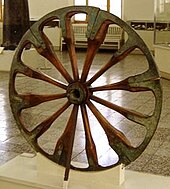
According to archaeologists, the wheel was invented around 4000 B.C. probably independently and nearly simultaneously in Mesopotamia (in present-day Iraq), the Northern Caucasus (Maykop culture) and Central Europe. Estimates on when this may have occurred range from 5500 to 3000 B.C., with most experts putting it closer to 4000 B.C. The oldest artifacts with drawings that depict wheeled carts date from about 3000 B.C.; however, the wheel may have been in use for millennia before these drawings were made. There is also evidence from the same period for the use of the potter's wheel. More recently, the oldest-known wooden wheel in the world was found in the Ljubljana marshes of Slovenia.[40]
The invention of the wheel revolutionized trade and war. It did not take long to discover that wheeled wagons could be used to carry heavy loads. Fast (rotary) potters' wheels enabled early mass production of pottery. But it was the use of the wheel as a transformer of energy (through water wheels, windmills, and even treadmills) that revolutionized the application of nonhuman power sources.

Example of medical technology

TAP 20™ for Point-of-Care Testing – SeventhSense

This Point-of-Care Testing can help doctors obtain patient’s blood without diagnosis. It comes with so many advantages which include:
– It’s painless for the patient.
-It keeps the blood sample until used for testing
Learn more about Point-of-Care testing here

  • Information Technology:  Information Technology  is a set of hardware and software tools used to store information. Information technology tools help in providing the right people with the right information at the right time. Knowledge workers in organization use information technology to complete various tasks and these can include; transferring of information which facilitates decision making with in an organization, improve customer service, and so much more. In this information age, it is very important to manage information systems to ensure accuracy and efficiency. Management information systems (MIS) involves planning for, development, management, and use of information technology tools to help knowledge workers and people perform all tasks related to information processing and management. Big financial institutions like ”BANKS” use information technology to operate their entire businesses as well as serve their customers.

Sunday, October 18, 2015

The Tech Awards

This signature program, presented by Applied Materials, honors 10 international laureates who are using technology to solve the world’s biggest challenges. Join us for our annual Gala on Thursday, Nov. 12, at the San Jose McEnery Convention Center.

DIY Haunted House Workshop


On Saturday, Oct. 17, create your own cardboard haunted (smart) house with MESH, a new DIY kit by Sony. Explore MESH’s intuitive drag-and-drop programming to wirelessly connect MESH Tags into all kinds of spooky configurations. From lights that turn off unexpectedly to ghastly shrieks triggered by vibrations, there’s no limit to what you can create!